
Patterns of Decision Making
Bayes' theorem and avoiding logic traps.

Design is a path of making thousands of decisions and trade-offs at every step. What process do you use? How do you gather evidence to drive those decisions? Can the data gathered challenge the gut instincts that kicked off the project? Let’s start with the Bottom Line Up Front (BLUF for my army friends):
Evidence should not determine beliefs; it should update them.1
The Bayes’ Theorem
The quote above is the summary of Grant Sanderson's video animation on Bayes’ Theorem. The word update is the key. When considering the probability, you should clarify the initial assumptions and test them for validity and accuracy, then assess how the new evidence alters the odds.
Looking to the origin of the theorem, belief was also a key word as the author, Thomas Bayes, was a philosopher, statistician, and Presbyterian minister. The theological application of the theorem was further developed by Richard Swinburne, who explored the application of Bayes' Theorem in "The Existence of God."2 Though without illustrations, the equations can be pretty daunting. Today, the theorem that captures how surprisingly unintuitive statistics can be is a powerful tool in many industries, including AI and Machine learning. It has traveled far and wide from its first publication in the Royal Society in 1763.
I’ll spare you the equations; many have documented them well. Instead, we'll look at a few logic traps it sheds light on. The first is a simple base case of careful updating a guess given new evidence. A simplified mode from an old game show, Let’s Make a Deal, hosted by Monty Hall.
The Monty Hall Brain Teaser
Three doors, three prizes: two goats and one new car. The setup begins, and one game-show host who knows the answer. “Pick any door,” you do. But are you sure? You are teased with the revelation of a mistake you might have made. “Glad you didn’t choose this goat,” Montey goads. “Are you still sure, or do you want to switch your current guess for the one door remaining?” Monty always gives you that second chance, “stay or swap?” He asks.
There you are, everyone watching, the audience waits and cheers, no stress here. Do you make the rational choice or the irrational choice? And which option is rational, which is irrational, and why?
This is the essence of Bayes’ Theorem. How does new evidence factor in? Sorry, I won't solve it for you. Evidence has shown that the moment of click occurs differently for each individual, and certified geniuses have squabbled over the answers. You can find explanations in academic texts3 and humorous online explainers4. I’d love to see you post your experience below.
Two more gotchas: Sunk Cost Fallacy and the Bayesian Trap
Two other corollaries are also examples of not processing new evidence well.
The sunk cost fallacy5 is the inclination to stick to your initial bet. It’s why people hold on to a stock expecting it to rebound after a market slump. Where, in contrast, if you look at the situation as a new snapshot in time. It is likely (or even more likely) that another stock will rebound quicker.
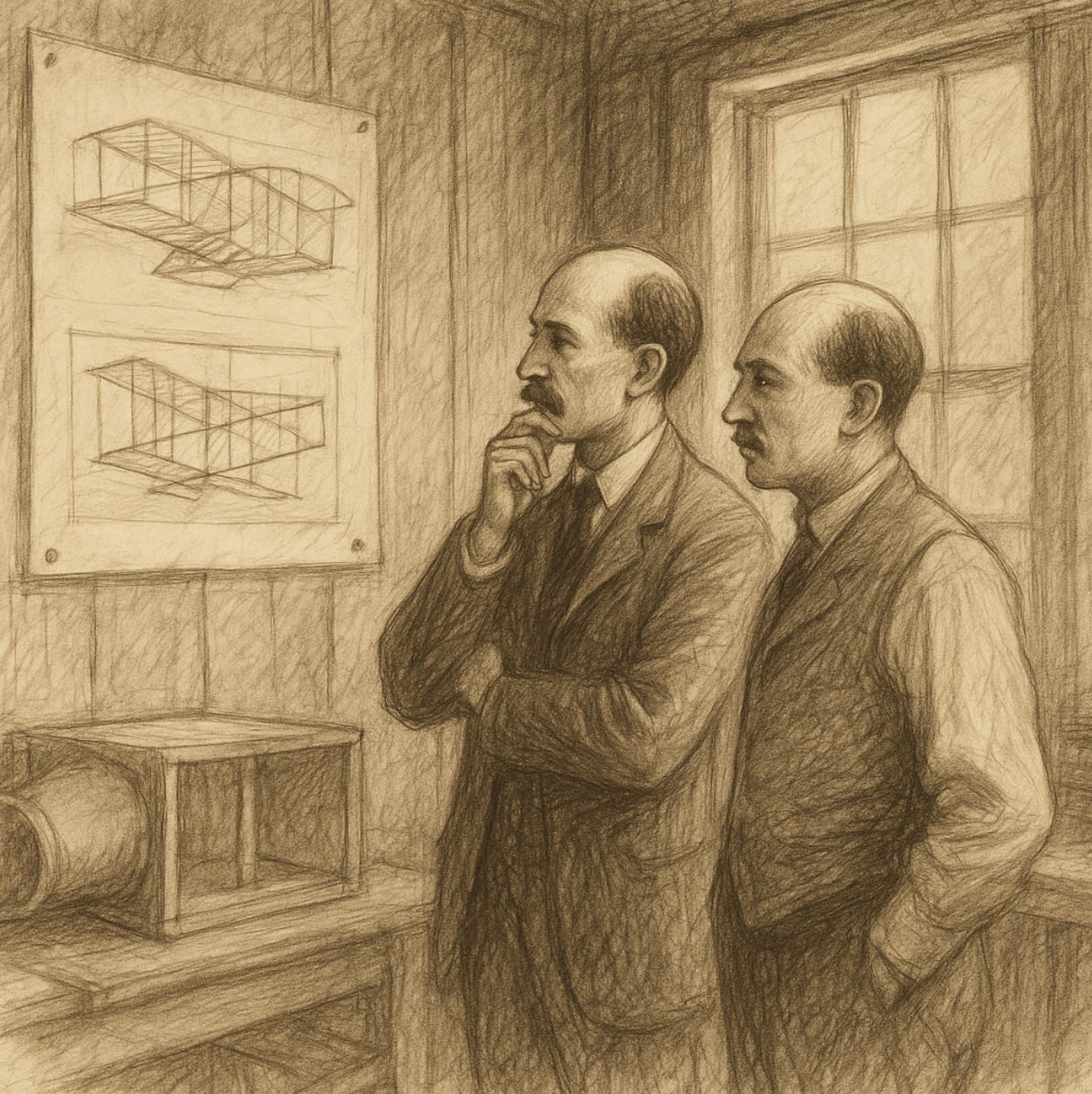
The Bayesian Trap6. If the Wright brothers had stuck to career probabilities, they would have pursued the “safer bet” in newspapers and bicycles. That anybody feels a call to try something never done before is evidence of inspiration. The term “Bayesian Trap”, a recently coined term, describes the points where the previous probability is assumed to be equal to or near 0 or 1 (e.g., the chance of making the first functional airplane appeared near 0). The trap is the point where substantial evidence has little impact. To the believer, this is counter to the principle of hope. Inspiration is the God-given ability to look beyond the valley.
The steadfast love of the LORD never ceases;
His mercies never come to an end;
They are new every morning.
Great is your faithfulness.
“The LORD is my portion,” says my soul,
“therefore I will hope in him.”
Lamentations 3:22-24 ESV
This post is an adaptation of homework for a graduate class in apologetics and philosophy. I’d appreciate comments below! During my CS career days, I saw Bayes ’ theorem in AI, ML, control theory, and design planning. The learning is now full circle.
- P. F. Austin
Grant Sanderson, “Bayes’ Theorem, the Geometry of Changing Beliefs”, 3Blue1Brown, YouTube video, published ~June 2019), 10:19–10:49 (time stamp 10:19),
The attached link starts near the conclusion. If you have the time, the whole video is excellent.
Richard Swinburne, The Existence of God, 2nd ed. (Oxford: Clarendon Press, 2004).
Jeff Gill, “Background and Introduction,” Bayesian Methods: A Social and Behavioral Sciences Approach (Boca Raton, FL: Chapman & Hall/CRC, 2002), 13.
Brady Haran, “Monty Hall Problem (best explanation)”, Numberphile, YouTube video, published May 28, 2014,
David A. V. Andrews and Daniel T. Gilbert, “Loss Aversion as a Potential Factor in the Sunk‑Cost Fallacy,” Journal of Behavioral Decision Making 33, no. 2 (April 2020): 123–32, accessed July 15, 2025, https://www.ncbi.nlm.nih.gov/pmc/articles/PMC7318389
The Bayesian Trap,” Veritasium, YouTube video, (May 2017).